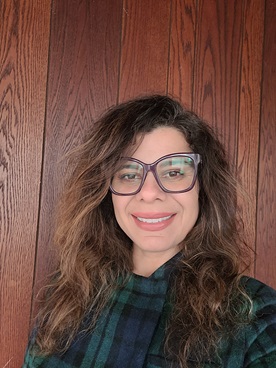
Welcome! I am an Assistant Professor in the Department of Mathematics at CUNY—New York City College of Technology (City Tech), with an appointment at the CUNY Graduate Center.
My research lies at the intersection of functional analysis, applied mathematics, and machine learning. I am interested in the mathematical foundations of data representation and learning: how complex scientific data can be represented, transformed, and reconstructed while preserving meaningful geometric and structural information.
Much of my recent work focuses on LiDAR and three-dimensional point-cloud data. I use ideas from measure theory, functional analysis, geometry, and numerical computation to develop and study mathematically motivated representations of these data. Current directions include product coefficients, reconstruction and hidden representations in autoencoders, multiscale and adaptive representations of LiDAR scan-line data, and applications to remote sensing and environmental data.
Student Research
I enjoy collaborating with undergraduate students on research.
Yeshiva College C.S. Students Summer Research with Dr. Patricia Medina
Current Research Directions
Selected current and developing projects
Mathematical Representations for LiDAR / 3D Point Clouds
Developing mathematically motivated representations of three-dimensional point-cloud data, including Product Coefficients, multiscale geometric features, and methods for preserving meaningful structure in classification and learning problems.
Reconstruction and Representation Learning
Studying reconstruction, information preservation, and hidden representations in autoencoders and related learning systems, with particular interest in repeated maps and the mathematical structure of learned representations.
Functional-Analytic Methods for Data Representation
Investigating how ideas from functional analysis, including Orlicz spaces and Luxemburg-type norms, can yield adaptive representations that respond to local geometric and density variation in LiDAR scan-line data.
Remote Sensing and Environmental Data
Applying mathematical and machine-learning methods to environmental and geospatial data, with developing projects involving permafrost vulnerability, multiscale remote-sensing data, and natural-hazard applications.